Executive English Coaching
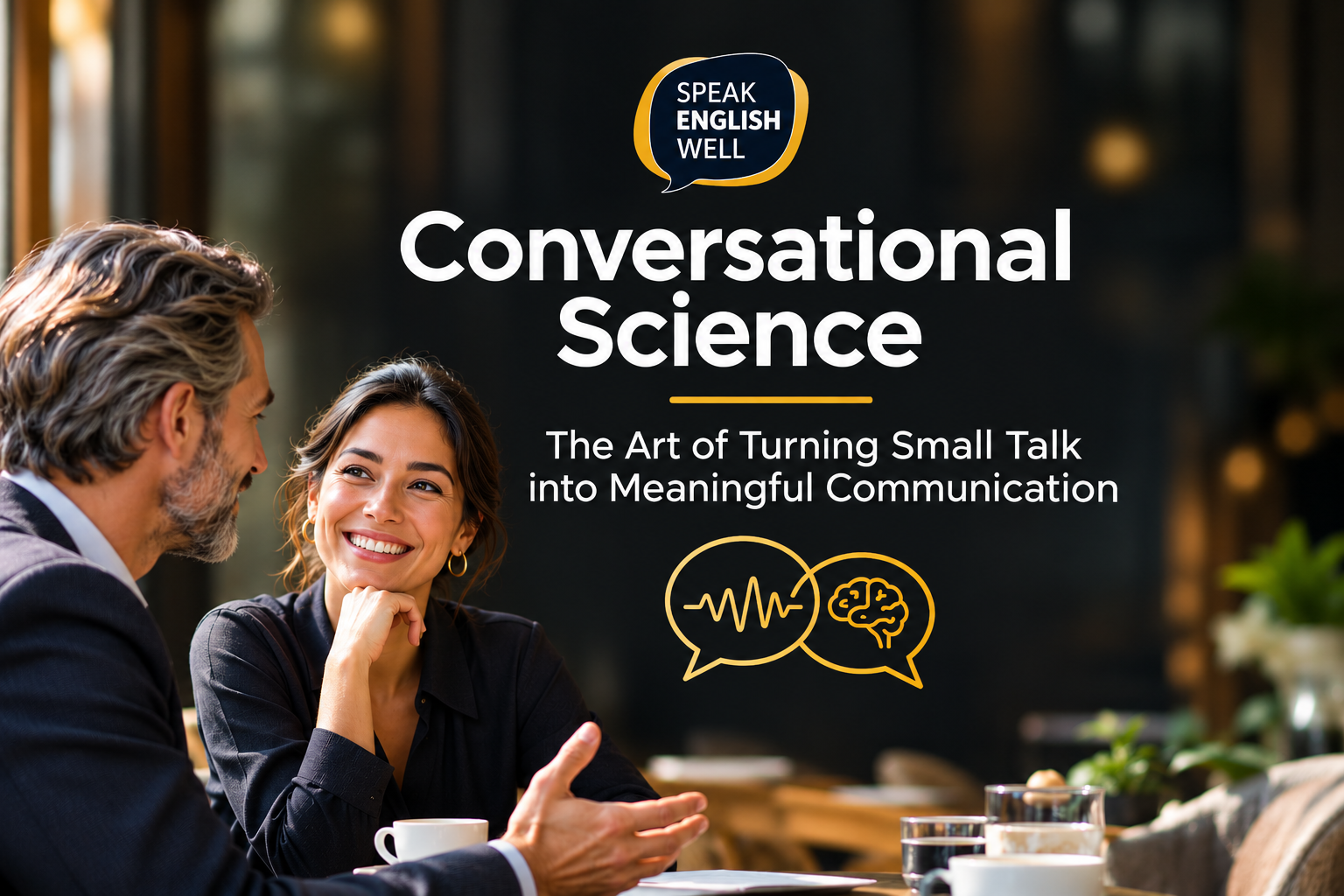
Conversational Science – The Art of Turning Small Talk into Meaningful Communication

Why understanding how conversations work can transform the way we connect, communicate and build relationships.
We spend much of our lives in conversation, yet rarely stop to consider how conversations actually work.
Why do some conversations flow effortlessly while others feel awkward? Why can a brief exchange with a stranger develop into a fascinating discussion, while a conversation with someone we know well sometimes goes nowhere? And why are some people naturally able to move from small talk to something much more meaningful?
The answers lie partly in what I call “conversational science“: a unique method that looks at how people interact through speech, listening, timing, language and social behaviour.
Conversational science is a central part of my coaching methodology at Speak English Well. I use as a practical method for helping senior professional and executives become more natural, curious, confident and effective communicators.
Small Talk Is Not So Small

Small talk is sometimes dismissed as superficial or unimportant. In reality, it performs a remarkably sophisticated social function.
When we talk about the weather, a journey, a shared experience or something happening around us, we are doing much more than exchanging information.
We are establishing a connection.
We are discovering whether the other person is interested in engaging with us, finding common ground and gradually building a sense of familiarity.
Consider a simple exchange at a professional conference:
“Have you travelled far to get here?”
“Yes, I’ve come from Copenhagen.”
“Oh, Copenhagen. I’ve always wanted to visit. What’s it like living there?”
What began as an ordinary question about travel has created several possible directions for the conversation.
It might lead to a discussion about architecture, culture, professional experiences or even personal ambitions.
Small talk is often the doorway to what I call “big talk”.
The skill lies in recognising when and how to move through that doorway.
The Science of Moving from Small Talk to “Big Talk”
Conversations are not simply sequences of questions and answers. They are collaborative activities in which two or more people continuously respond to one another.
Researchers studying conversation have identified important patterns in turn-taking, timing, conversational repair, shared attention and the ways people introduce and develop topics.
One particularly useful principle is that a conversation develops through what each person contributes to the exchange.
Imagine someone saying:
“I’ve just returned from Japan.”
A conventional response might be:
“Was it nice?”
But a more curious response could be:
“What surprised you most about being there?”
The second question creates an opportunity for a more personal, reflective and interesting answer.
The conversation can move beyond facts towards experiences, feelings and ideas.
This is one of the practical applications of “conversational science” in my coaching: helping people recognise opportunities to develop a conversation naturally rather than simply keeping it going.
Curiosity Is More Important Than Having Something Clever to Say
Many people approach conversation with the belief that they need to be interesting.
They worry about finding the right words, asking impressive questions or having something intelligent to contribute.
But effective conversation often begins with something much simpler: genuine curiosity.
When we become interested in another person’s experience, we begin to notice details that might otherwise pass us by.
We ask better follow-up questions.
We listen more attentively.
And we become less preoccupied with what we should say next.
For international professionals communicating in English, this can be particularly valuable.
Instead of concentrating exclusively on producing grammatically perfect sentences, they can begin to focus on the purpose of the conversation itself.
Language becomes a means of exploring ideas and building relationships rather than a performance that must be judged.
The Conversations Between the Meetings
Some of the most important professional conversations happen outside formal meetings.
They take place in corridors, lifts, cafés, conference receptions and the few minutes before or after a presentation.
These informal exchanges can help colleagues develop trust, discover shared interests and understand one another beyond their professional roles.
Yet they can also be surprisingly challenging, particularly when communicating in a second language.
Formal meetings usually provide a clear structure. There is an agenda, a subject and an understood purpose.
Informal conversations are less predictable.
You may need to introduce a topic, respond spontaneously, recognise humour, change direction or decide when to end the exchange.
“Conversational science” helps us understand these less obvious aspects of communication.
In my coaching, we can explore the small decisions that shape these interactions: how to enter a conversation, how to keep it moving, how to introduce a more substantial subject and how to leave naturally.
These are skills that can be observed, understood and developed.
Rhythm, Pauses and the Unspoken Rules of Conversation
Conversation is not only about words.
Timing plays an enormous role.
We instinctively notice when someone hesitates, interrupts, responds enthusiastically or leaves an unusually long pause.
These subtle signals influence how we interpret confidence, interest, warmth and understanding.
Conversational research has shown how carefully people coordinate their speaking turns, often with remarkably little silence between them.
But effective communication is not about eliminating pauses.
Sometimes a pause allows an idea to develop. Sometimes slowing down gives another person the opportunity to contribute.
And sometimes silence communicates attention more effectively than another question.
This connects conversational science directly to my work with speech rhythm, pacing, pausing, projection = (prosody) and pronunciation.
The way we say something can be just as important as the words we choose.
Conversational Science as a Coaching Method
At Speak English Well, conversational science is not simply something I coach people about.
It is part of how I coach.
My approach combines observation, linguistic knowledge, curiosity and creative problem-solving.
I pay attention to how someone develops an idea, responds to a question, manages a pause, changes a subject or navigates an unexpected conversational moment.
We can then explore these patterns together.
Sometimes the solution involves language: finding a clearer expression or a more natural way to phrase a question.
Sometimes it involves rhythm, intonation or the ability to slow down.
And sometimes it involves a different way of thinking about conversation altogether.
Rather than treating communication as a collection of rules to memorise, I use conversational science as a practical framework for understanding what happens between people when they speak.
Importantly, this is not a rigid formula.
Every person brings their own personality, professional experience, cultural background and way of thinking to a conversation.
My role is to use the science creatively, adapting it to the individual rather than expecting the individual to fit the method.
A Simple Exercise: From Small Talk to Big Talk
The next time you have an informal conversation, try the following.
1. Begin with something ordinary.
Ask about a journey, an event, a shared experience or something happening around you.
2. Listen for something interesting.
Pay attention to a detail that could lead somewhere.
3. Follow the detail rather than changing the subject.
If someone mentions a place, an experience or a project, explore it.
4. Move gradually towards a more meaningful question.
For example:
- “How was your trip?”
- “What took you there?”
- “What did you find most interesting?”
- “Did the experience change the way you think about anything?”
Notice how the conversation gradually moves from factual information towards personal experience and reflection.
The objective is not to force a deep conversation. It is to recognise when a natural opportunity arises.
And remember that conversation is reciprocal. Sharing a relevant thought or experience of your own is just as important as asking questions.
Beyond Speaking English Well
My work has always been about more than correcting grammar or improving pronunciation.
I am interested in how people think, how they express ideas and how language influences the relationships they develop with others.
“Conversational science” brings many of these interests together.
It helps us understand why conversations succeed, why they sometimes fail and how relatively small changes in our behaviour can make a significant difference.
For senior professionals, these skills can influence everything from informal networking and professional relationships to leadership, collaboration and complex discussions.
For anyone communicating in a second language, they can also help make conversation feel less like an examination and more like a natural human experience.
Ultimately, the aim is not to become someone who always knows exactly what to say.
It is to become someone who can listen, respond, think creatively and participate comfortably in the unpredictable and fascinating process of conversation.
Because great communication is not simply about speaking well. It is about thinking, listening and connecting well.
Charles Richardson
Speak English Well — Executive Communication & Speech Coaching
The Richardson Method | Conversational Science | Speech & Communication
A Note on the Richardson Method
The concepts of Conversational Science and Big Talk, as presented in this article, form part of my own Richardson Method. They have been developed through years of practical coaching, observation and creative exploration of how people communicate. My approach brings together established research into human conversation with my own techniques for helping individuals develop more natural, meaningful and effective communication. Published Nov 4 2026